
Organization
Kitchen organization that makes planning faster
Set up your pantry zones and labels so inventory stays accurate with minimal effort.
2/9/2026 · 5 min read · Pantri Team
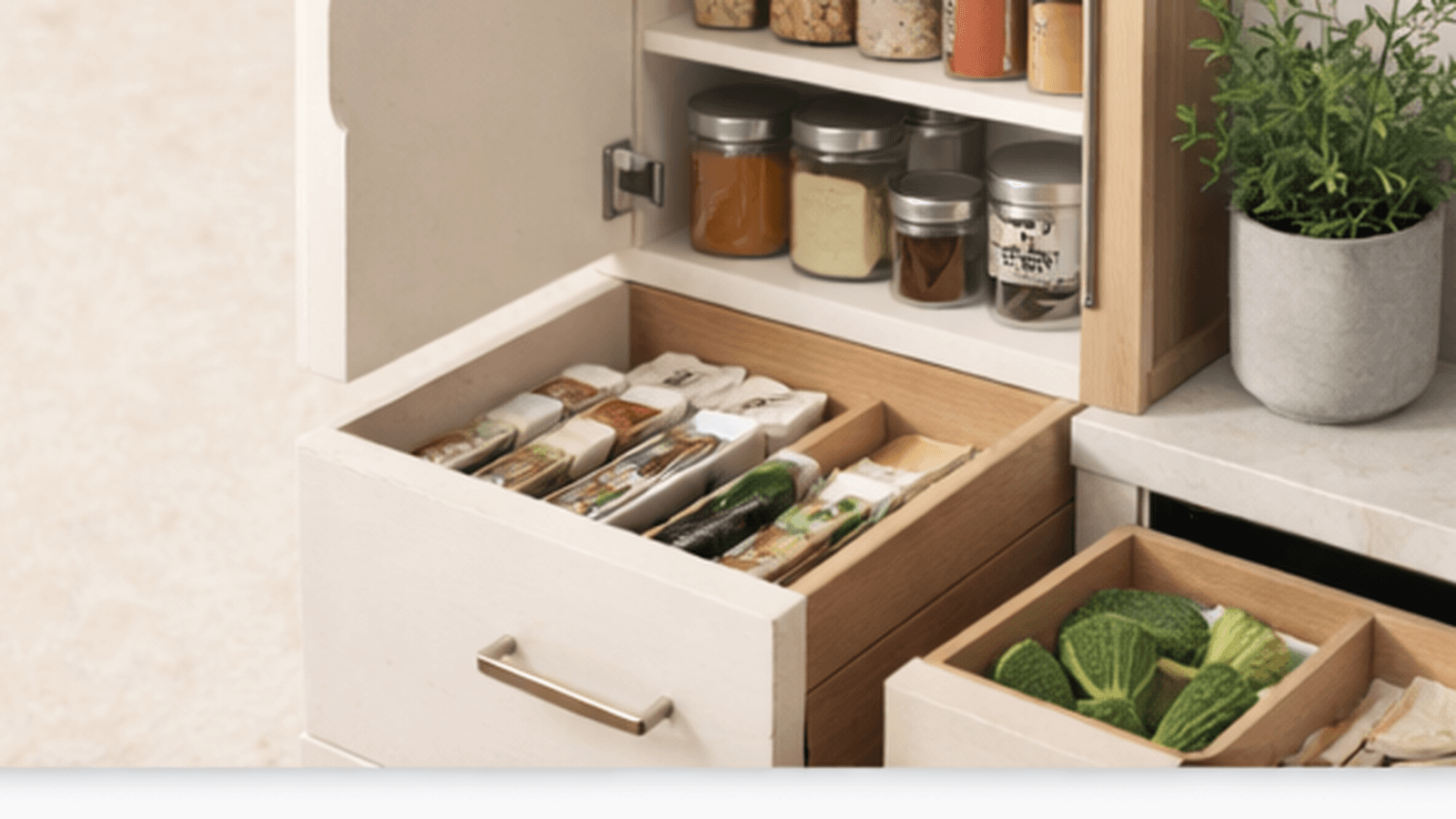
Kitchen organization advice usually focuses on aesthetics — matching containers, labeled jars, color-coordinated shelves. That's not what this is about.
The kind of organization that makes meal planning faster is about one thing: retrieval speed and inventory confidence. Can you quickly find what you're looking for? And more importantly, do you know what you have without having to open every cabinet?
When those two things are true, your digital pantry stays accurate with minimal effort, and your planning sessions become shorter and more reliable.
Why physical organization and digital tracking reinforce each other
Most people think of kitchen organization and app-based inventory tracking as separate things. They're not. The way your physical kitchen is organized directly affects how accurate and easy to maintain your Pantri inventory is.
If your dry goods are spread across three different cabinets with no consistent location, you'll miss items when scanning receipts because you'll forget they exist. If proteins are mixed in with condiments, the mental model of what you have is harder to maintain. If your freezer is a mystery drawer, you'll almost certainly have phantom inventory — items you think you have that you don't.
Organizing your physical kitchen to match the category structure your app uses means your brain and your digital inventory are working from the same model. Updates are faster because you know exactly where things live. Accuracy improves because the physical organization makes gaps visible.
The five zone framework
Pantri organizes pantry items into five categories: produce, protein, dairy, pantry (dry goods and shelf-stable), and frozen. Building your kitchen organization around those same five zones creates a direct correspondence between what you see in the app and what you see in your kitchen.
Produce. Keep produce together, ideally in a visible spot — a bowl on the counter, a dedicated drawer in the fridge, a basket on a shelf. The goal is that you can see at a glance what produce you have and how fresh it looks. Out-of-sight produce is the primary driver of waste.
Protein. Meats, fish, eggs, and protein-forward dairy (Greek yogurt, cottage cheese) should live in a consistent spot. In the fridge, a dedicated shelf. In the freezer, a dedicated zone. When you know exactly where your proteins are, you can scan and update your inventory accurately and quickly.
Dairy. Milk, cheese, butter, cream, yogurt: consistent placement means you always know what you have without checking. The fridge door is a common spot for some dairy, but make sure the placement is consistent enough that you know to look there.
Pantry (dry and shelf-stable). This is usually the largest and most varied category: grains, pasta, canned goods, cooking oils, vinegars, spices, baking ingredients, snacks. Grouping these by type within the pantry zone — all grains together, all canned goods together — makes it easier to see gaps and easier to scan accurately.
Frozen. The freezer is where organization typically breaks down. Proteins in a dedicated zone at the front, vegetables together, prepared items together. A freezer you can read at a glance is one you'll actually use and maintain.
Standardizing your naming
When you add items to Pantri, either through scanning or manual entry, the name becomes part of your search and planning vocabulary. Consistent naming means better results when the AI is generating recipes against your inventory.
A few conventions that help:
Match generic names over brand names. "Chicken thighs" is more useful than "Foster Farms Bone-In Chicken Thighs 3.2lb." The app can use "chicken thighs" to match against recipe ingredients. The brand name doesn't contribute to that.
Include the form when it matters. "Canned tomatoes" and "fresh tomatoes" are different ingredients for planning purposes. "Whole milk" and "oat milk" are different. When the form affects what you can cook with it, include it.
Keep it brief. The name should be recognizable at a glance. "Dried red lentils" is enough. "Red lentils (dried, from bulk bin, bought at Whole Foods)" is not useful as a pantry entry.
Consistency across your household matters too. If one person enters items as "ground beef" and another as "beef mince," you end up with duplicate entries that the app can't merge. Agreeing on naming conventions early avoids this.
The weekly reset habit
No organization system stays clean indefinitely. The weekly reset is the habit that keeps it functional.
Spend five minutes once a week — typically before or after your planning session — doing a quick inventory check. Look at your produce and note what's getting close. Check the fridge for anything that needs using. Scan the pantry shelves quickly for items that are running low.
This serves two purposes. It keeps your Pantri inventory current even between shopping trips, when things get used without a formal update. And it gives you a use-first view of your kitchen before you start planning, so your meals for the week start from reality rather than assumption.
The reset doesn't need to be thorough. A five-minute walk-through that catches the obvious things — the spinach that needs using, the can of beans you thought you had but don't, the oil that's getting low — is enough to keep the system honest.
What a well-organized kitchen actually produces
The downstream effect of a well-organized kitchen with an accurate digital pantry is that planning becomes faster and more reliable.
When your pantry is organized, you scan receipts more accurately because you can verify items against what you see physically. When items are in consistent zones, you know immediately when something is low. When your naming conventions are consistent, recipe generation works better because the AI can match ingredients more reliably.
None of this requires a perfect kitchen or a significant time investment. The goal is a system that's accurate enough to plan from and easy enough to maintain that you actually maintain it. That's the whole thing.
A tidy pantry isn't the goal. A reliable system is. The difference is whether you're organizing for photos or organizing for decisions.
Related posts

Scanning
How to scan receipts into a pantry you can trust
Use receipt scanning without sacrificing accuracy by adding one quick review habit.
1/24/2026 · 5 min read
Planning
How to reduce food waste with a pantry-aware meal routine
A practical weekly rhythm that uses what you already own first, then fills only what is missing.
1/16/2026 · 6 min read